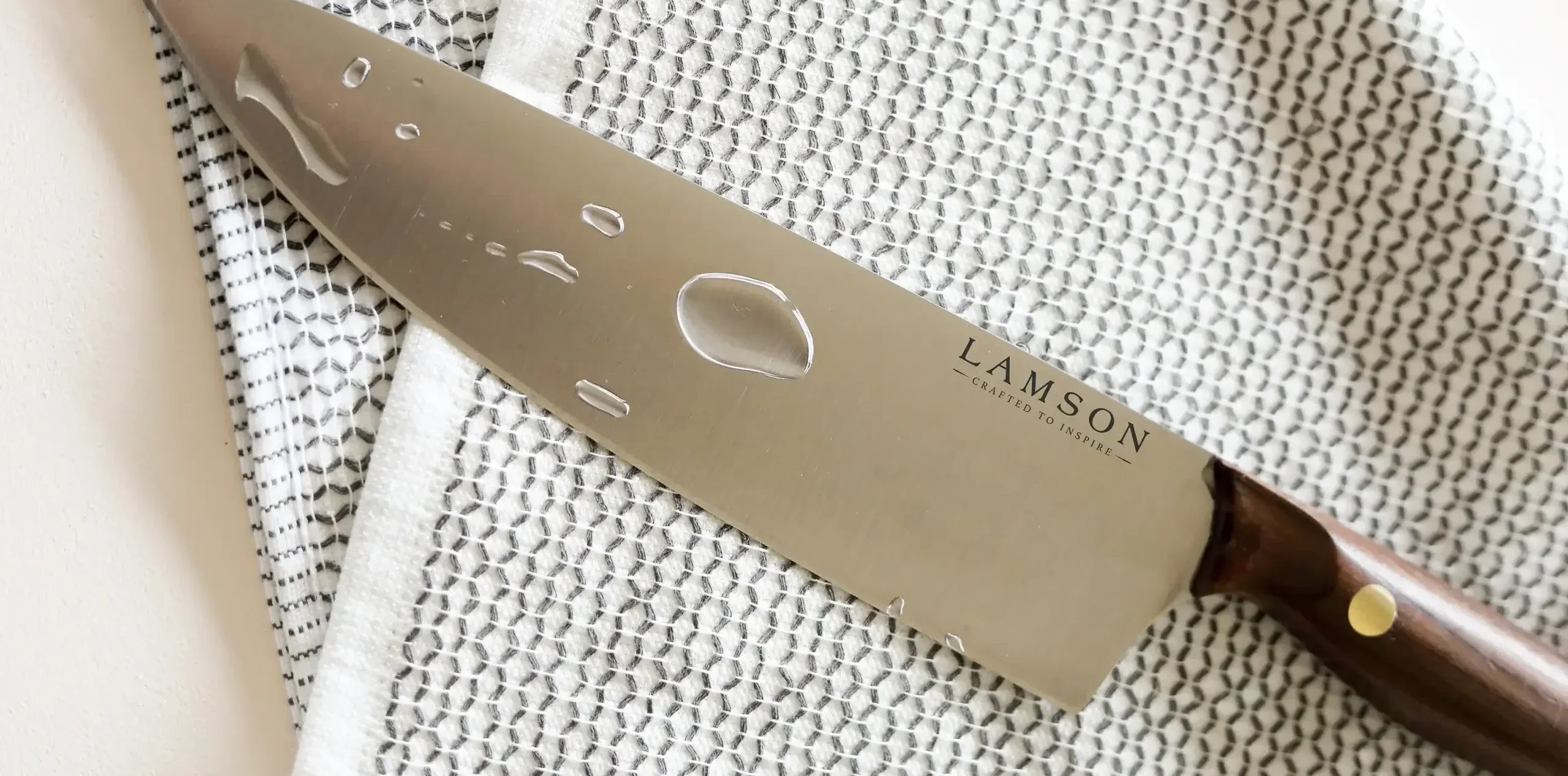
Not all edges are created equal. The angle of an edge plays an important role in how a tool performs, and different tools are designed around different angles for a reason.
For National Knife Month, we’re taking a closer look at what those numbers actually mean and why the right edge angle depends on the job.
What Is a Knife Edge Angle?

When we talk about a knife’s edge angle, we’re talking about the angle at which the edge is sharpened.
A more acute angle creates a finer, more precise edge. A more robust angle creates an edge designed to withstand more demanding applications.
That doesn’t mean one angle is better than another.
It means the angle is part of the tool’s design.
A small paring tool used for precision work doesn’t necessarily need the same edge geometry as a cleaver. And a specialized tool like a pizza rocker has its own requirements, too.
From Fine to Robust
Here’s a look at a few Lamson tools and their recommended sharpening angles:
 15° | Paring Knife

Precision & detail
The 3½” Paring Knife is designed for smaller, more precise tasks where control matters.
Recommended sharpening angle: 15°
 15–18° | Steak Knives

A finer edge for the table
Steak Knives are designed around a finer edge for clean, controlled cutting at the table.
Recommended sharpening angle: 15–18°
 18–20° | Chef Knife

Everyday prep
A chef knife is one of the kitchen’s most versatile tools, handling everything from chopping and slicing to everyday food preparation.
Recommended sharpening angle: 18–20°
 18–20° | Ulu

Specialized prep
Here’s where things get interesting. The Ulu and Chef Knife may look and feel completely different, but they share the same recommended sharpening range.
Recommended sharpening angle: 18–20°
 20–22° | Heavy Duty Meat Cleaver

Heavier prep
A cleaver calls for a more robust edge, suited to a tool designed for heavier kitchen work.
Recommended sharpening angle: 20–22°
SHOP OUR HEAVY DUTY MEAT CLEAVER
 22–24° | Pizza Rocker

Specialized cutting
The Pizza Rocker sits at the more robust end of our examples, with a recommended sharpening angle of 22–24°.
Recommended sharpening angle: 22–24°
So, What’s the “Best” Angle?

There isn’t one.
The best edge angle depends on the tool, the materials it’s designed to work with, and the job it’s meant to perform.
A finer edge can be ideal for precision. A more robust edge can provide greater durability for demanding applications.
The goal isn’t the sharpest possible edge. It’s the right edge for the job.
The Takeaway
The next time you pick up a Lamson tool, take a look at the job it’s designed to do. Different tools. Different jobs. Different edges. That’s what makes the angle matter.
A Note on Hand-Finished Edges: At Lamson, our edges are hand finished, so recommended sharpening angles should be viewed as guidelines rather than a promise that every individual edge measures exactly the same degree. The goal is a properly finished edge that matches the intended design and use of the tool.